Travel back in time to the great halls and vaulted cellars of Bremen’s historic Town Hall
I was in Bremen once, on a cold and wet winter’s day. The sky was Cimmerian and the rain biblical, making the cobblestones on the main square look as though they were simmering in oil. I ducked into the town hall for some respite and, for the briefest of seconds, with the din of the rain still roaring in my ears, I looked up to see the keels of great ships, and I imagined that I must have entered an ethereal underwater world.
Postcard of Bremen Town Hall, c.1908. From the author’s own collection. Public Domain.
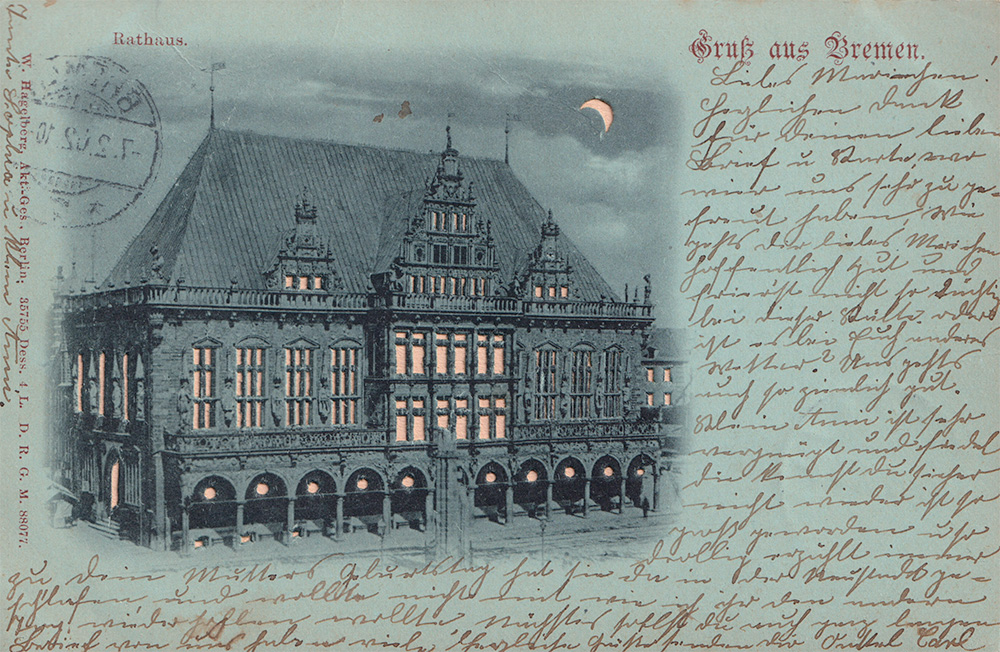
Bremen’s town hall sits at the heart of the city on its market square, and is one of Germany’s finest architectural treasures. The hall was built between 1405 and 1409 in a medieval gothic style. Its ornate façade was added in 1608, in a regional style referred to as Weser Renaissance, named after the river that flows through this part of Germany. The hall was built for both the city councillors, who continue to meet in rooms on the first floor, and for Bremen’s citizens, who have historically made use of the spaces on the ground floor.
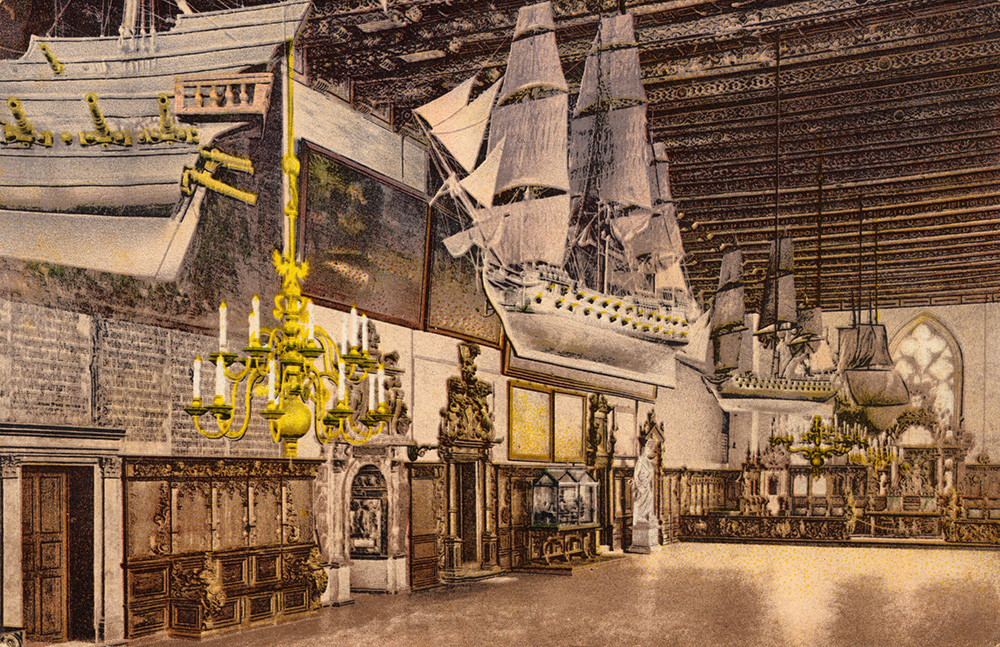
Baedeker’s Guide to Northern Germany tells us that, should you enter the town hall by its west entrance, and proceed up a flight of steps, you will find an upper hall that is “one of the finest examples of its kind in Germany”. It continues its description by saying that “from the ceiling, which is adorned with medallions of German emperors from Charlemagne to Sigismund, are suspended old models of ships.”1
The Great Hall, Bremen City Hall. Postcard from the author’s collection. Public Domain.
Bremen and the Hanseatic League
The model ships alluded to Bremen’s status as one of the most preeminent cities of the Hanseatic League, that medieval trading confederation that transformed the Baltic Sea and the German Ocean (or North Sea) into one great liquid continent.2 The Hanseatic League connected scores of port towns and cities across northern Europe, from London in the west to Novgorod in the east, Bergen in the north to Cologne in the south. But it’s worth noting that the models hanging from the ceiling in Bremen’s town hall were of warships rather than cargo vessels, serving as a reminder that in spite of its emphasis on commerce, the League had to protect its trade, by defence or by aggression.
Bremen joined the Hanseatic League in 1260, consolidating the its status as one of the most important cities in northern Europe. Indeed, the city is still known as Freie Hansestadt Bremen, and is the smallest of Germany’s sixteen states.
The Town Hall Cellar
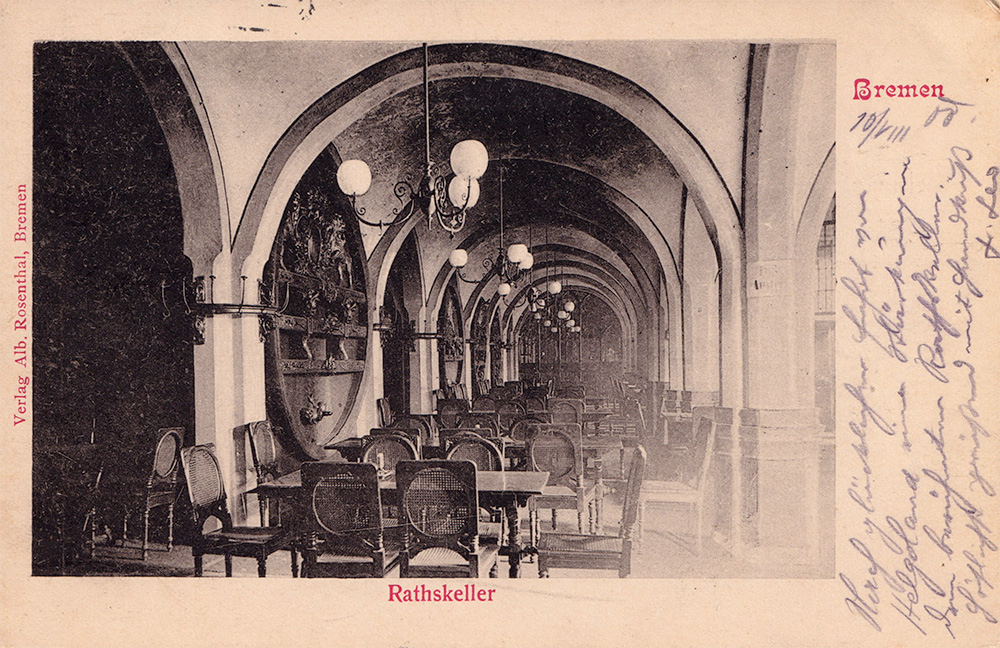
Another set of steps at the town hall’s west entrance lead down to the building’s cellars (Ratskeller) where, to this day, wine casks of immense age hold wines of immeasurable value. When the town hall was built in the fifteenth century the city council controlled the sale of wine in the city. Its wines were stored in specially designed cellars under the town hall. The wine casks in the Bremen Ratskeller contain German wines only.
Baedeker describes five rooms off the hall in the cellar: two salons, the Kaiser-Saal and the Bacchus-Saal. A third room, the Senator’s Room, contains a bronze statue of the ‘Bremen town musicians’: a donkey, dog, cat, and cockerel, as depicted in the Brothers Grimm’s fairytale.
Postcard of the Bremen Town Hall Cellar, 1910. From the author’s own postcard collection. Public Domain.
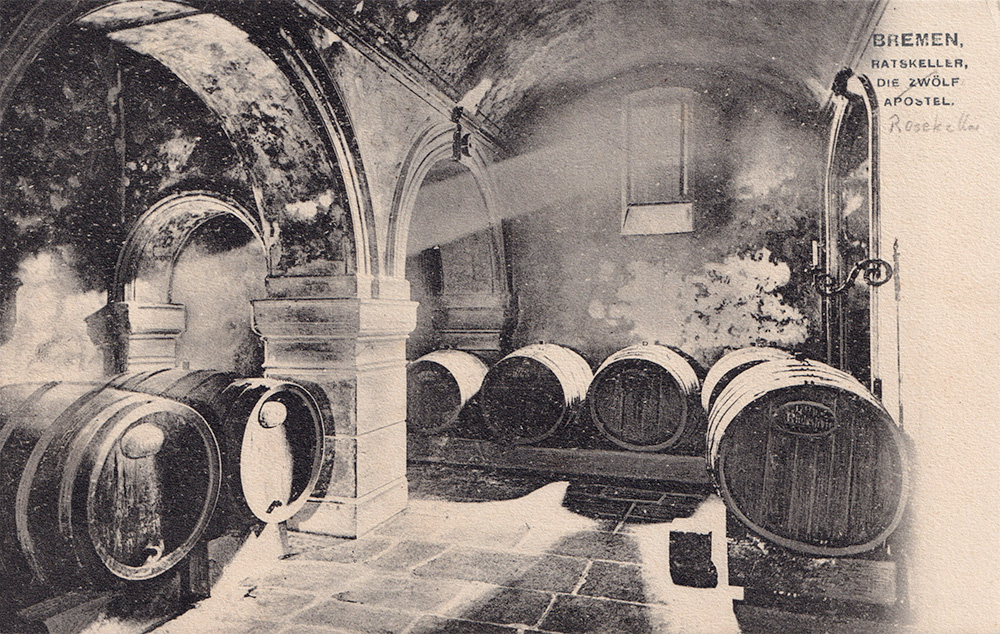
In another room are the twelve Apostles – twelve casks containing vintage wines. The last room is the Rose-Keller. It contains Germany’s oldest cask of wine, a rosé from Rüdesheim dating to 1653. None of these wines are for sale, and only on the very rarest of occasions is any liquid drawn from them for consumption. The last guest to sample the 1653 Rosenwein was Queen Elizabeth II, in 1978.
A visit to the wine cellar inspired the romantic poet and novelist Wilhelm Hauff to write his 1827 novella Phantasien im Bremer Ratskeller (The Wine-Ghosts of Bremen). In the book the author visits the Bremen Ratskeller on a stormy evening in September. Of his descent into the cellar, Hauff wrote:
What a noble sight was there! His [the cellarman’s] lantern shone over long rows of casks, and threw strange forms and shadows on the arches of the cellar; and the pillars seemed to float in the background like busy coopers plying their staves.3
The Wine Cellar under Bremen’s City Hall. Postcard from the author’s own collection. Public Domain.
Hauff also described the room where the Twelve Apostles were stored:
One ascends from Bacchus to a smaller vault, the subterranean celestial firmament I called it, the seat of blessedess, where dwell the twelve mighty casks, each called after an apostle. What funeral vault of a royal race can compare with such a catacomb as this?4
The Twelve Apostles in the Bremen City Hall’s Wine Cellar. Postcard from the author’s collection. Public Domain.
And the room where the 1653 Rudesheim rosé lay:
At last we reached it, the little garden of the queen of flowers. There she lay in all her majestic girth, the biggest cask I ever saw in my life, and every glass worth a golden guinea. Frau Rosa was born in 1615. Ah, where are the hands that planted her parent vine? Where are the eyes that watched the ripening clusters? Where the sun-browned feet that hurried to the festival when she was pressed in the sunny Rheingau, and streamed a pale gold rivulet into the vat? Like the waves of the stream that lapped the base of her cradle, they are gone no one knows whither. And where are their High-Mightinesses of the Hansa, who ruled when the Hansa was a League indeed, those worthy senators of Bremen who brought the blushing maiden to this cool grot for the edification of their grandchildren? Gone too — with two centuries over their heads, and we can only pour wine on their tombs.5
Postcard showing Bremen Town Hall by moonlight, 1912. From the author’s own collection. Public Domain.


 In the Jungle of Cities