In the early twentieth century this luxurious Hamburg hotel was the departure point for the first class passengers travelling to the Americas by steamship.
In May 2024 I travelled to Hamburg, where I stayed at the Atlantic Hotel, a stately 5-star pile overlooking the waters of the Außenalster lake. I don’t usually make a habit of staying in such luxurious surroundings, but this was my first trip to Germany in nearly five years, and I was celebrating, or to put it more accurately, commiserating, a forthcoming landmark birthday.
I can count the number of 5-star hotels I’ve stayed in throughout my life on one hand, which equates to one 5-star hotel for each decade. The opulence of the restaurant and bar, and the care and attention of the staff are obvious indicators of 5-star quality. But it’s also worth taking a moment – whenever the opportunity arises – to admire the most ordinary of fixtures and fittings in your room. The way that the taps in the bathroom need only a quarter of a turn to immediately bring forth hot water. The solidity of the walls and doors, through which not a sound from neighbouring guests can be heard. The quality of the bathroom soaps. Every door, cupboard, drawer, window, opens and closes with the utmost accuracy and without the slightest complaint.
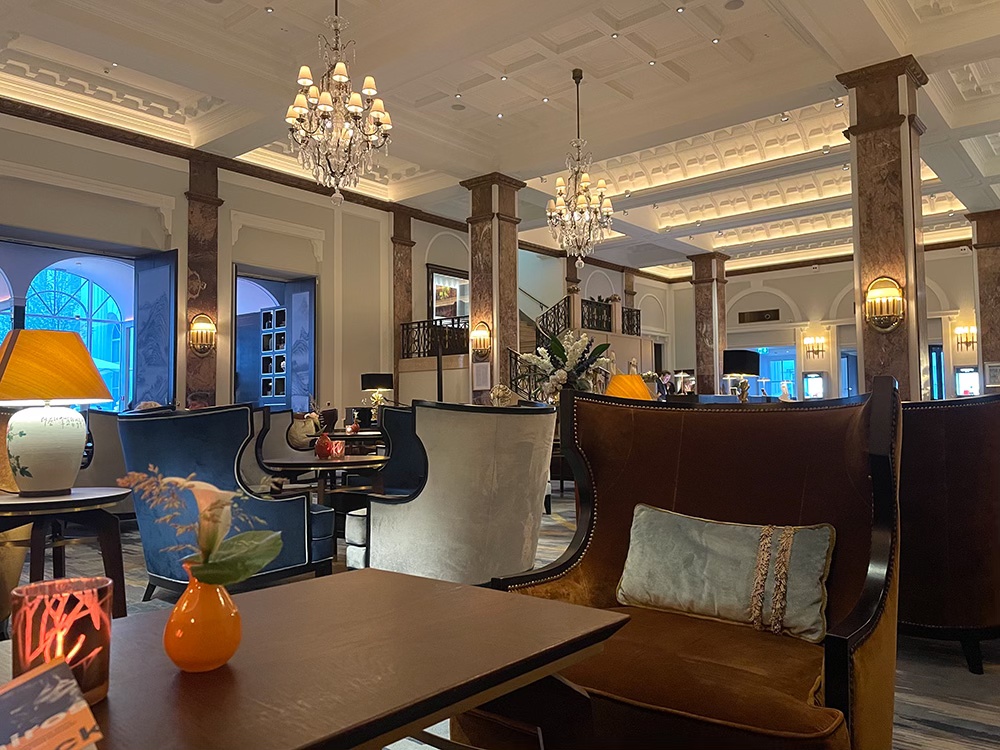
The best place in such a hotel is the lobby, where you can sit and watch the world go by – or at least a different world to the one you’re used to. Joseph Roth, the peripatetic novelist and chronicler of early twentieth-century Europe, liked hotel lobbies as well. In a newspaper column entitled Millionaire for an Hour, published during the traumatic post-war years in Germany, he wrote:
Every so often, I like to spend a little time in the lobby of the big hotel where visitors from hard-currency nations come to stay. The coffered ceiling consists of so many gorgeous panels, and in the middle of each one sprouts an electric light. The lamps look like glass flowers, shaded by golden leaves. The ceiling is low but expansive, the furniture likewise. Everything here tends to breadth and luxury. The low ceiling murmurs: Don’t get up! The broad armchairs say: Kick your shoes off! […] After just a quarter of an hour sitting like that, and feeling flush and expensive, I start to think I am someone from a hard-currency country, and am staying at the hotel.1
I might have been staying rather than lingering at the Hotel Atlantic, but I still empathised with Roth’s status as an outsider. And I can’t say that I felt completely comfortable sitting in the lobby, amongst immaculately dressed businessmen and wealthy American and Gulf tourists.
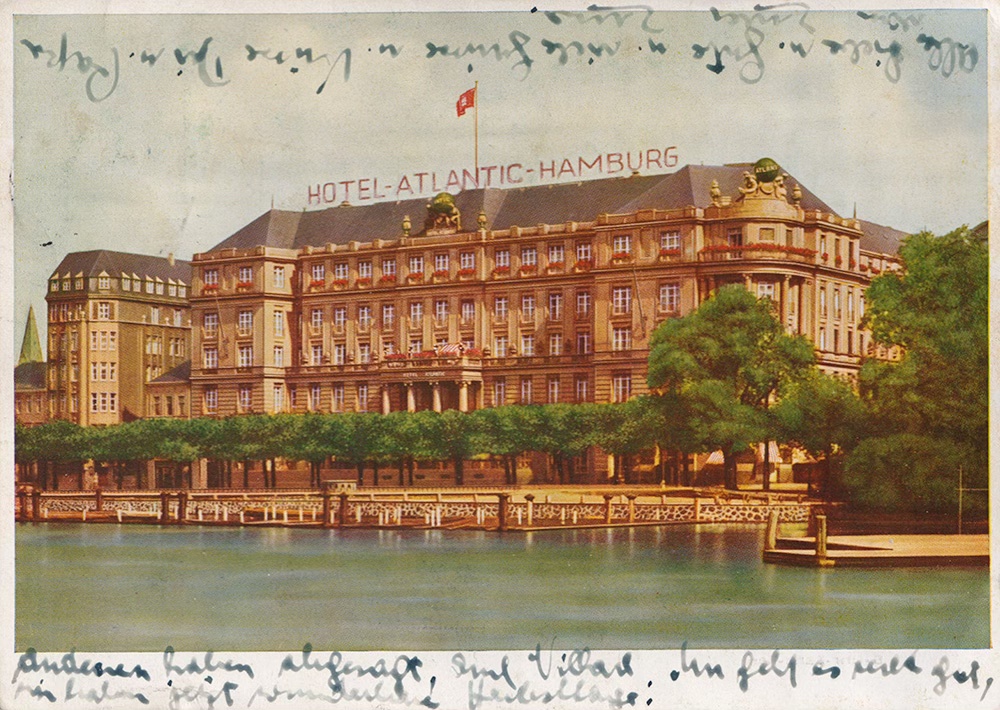
The Hamburg-Amerika Line, a transatlantic shipping company, opened the Hotel Atlantic on 2 May 1909. The company had been founded in 1847, and by the beginning of the twentieth century had become one of the world’s largest shipping companies. In 1900 the Hamburg-Amerika Line opened a new shipping terminal at Cuxhaven on the North Sea coast, a short railway journey from Hamburg’s main station, which itself was just a five-minute walk away from the Hotel Atlantic. And it was strange to think, as we walked each day from the hotel to the station, to catch a U-Bahn train to the next attraction on our itinerary, that the walk was one that many had done before, on their way to catch an ocean liner across the Atlantic. And I could imagine the bustle in the hotel lobby, filled with travellers with their cases and bags, on the cusp of departing one continent for another.
But very few of the passengers who were about to embark on a transatlantic voyage, and probably in a first class cabin, were affluent enough to stay in the 5-star Hotel Atlantic. They were vastly outnumbered by those in steerage, who were travelling to the United States in search of a better life. The Hamburg-Amerika Line’s success was driven by the huge numbers of Europeans who emigrated from the Continent to the United States – some six million between 1820 and the First World War. Many were seeking to escape poverty during a period of agricultural crisis in Europe. Others were political refugees, leaving Europe in the wake of the 1848 revolutions. Many were Jews, looking to escape the pogroms and persecution.
The sociologist Edward Steiner, who had himself emigrated to the United States as a political refugee from Austria, wrote in 1906 of the emigrants gathering in Hamburg for their passage to the United States. He described how they were given baths and had their clothing disinfected, leaving them smelling ‘of hot steam and carbolic acid’. Steiner also observed how even on the most elegant liners, such as the Kaiser Wilhelm II, 900 steerage passengers could be packed like cattle into the bowels of the ship:
On the whole, the steerage of the modern ship ought to be condemned as unfit for the transportation of human beings; and I do not hesitate to say that the German companies, and they provide the best for their cabin passengers, are unjust if not dishonest towards the steerage.2
Which brings us back to Joseph Roth, who sat in the affluent hotel lobby and acknowledged his status as an imposter, for he was all too familiar with the plight of those that emigrated from Europe as steerage passengers. He knew where they’d come from, and the lives they’d left behind.
Roth has been on my mind a great deal of late. Earlier this year I read Keiron Pim’s excellent biography Endless Flight. By chance I next read Jacob Mikanowski’s Goodbye Eastern Europe, which brought to life the world in which Roth grew up, and repeatedly returned to in his fiction. Roth’s 1930 novel Job, a retelling of the biblical Book of Job, charts the journey of an Orthodox Jew and his family from the hinterlands of the Russian Empire to New York.
It was still early when they reached the ship. They were permitted to cast a few glances into the dining rooms of the first and second class before they were pushed into steerage. Mendel Singer didn’t move. He stood on the highest step of a narrow iron ladder, at his back the port, the land, the continent, his home, the past.3
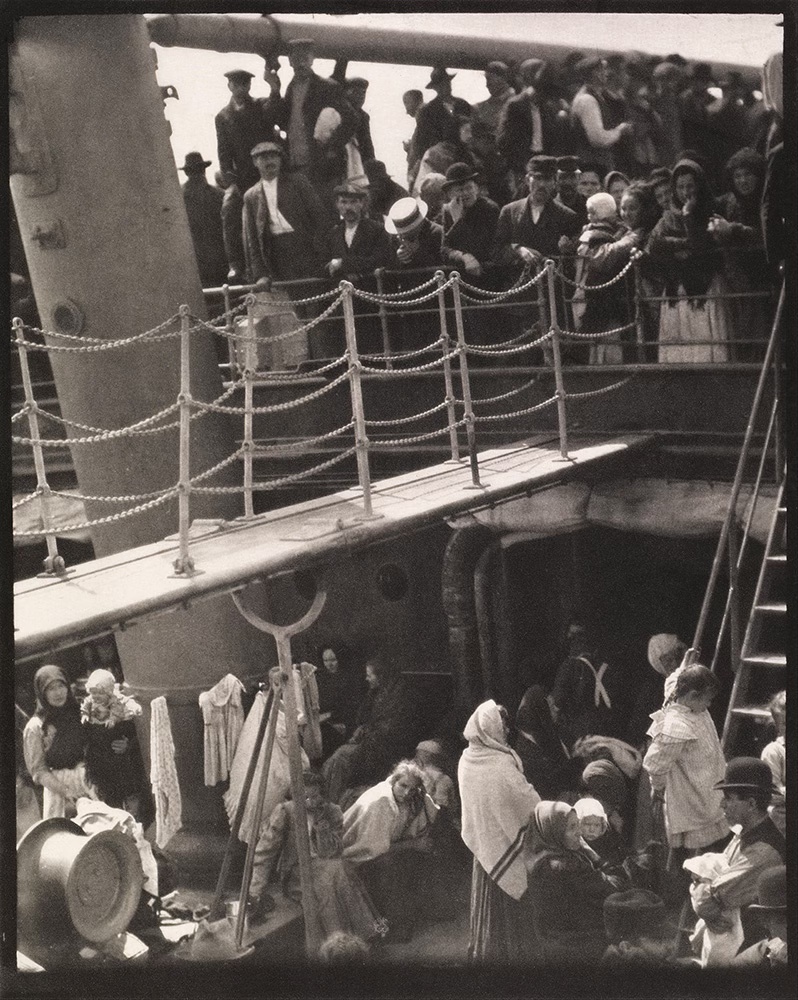
There are at least six million unique stories of emigration from Europe, spread out across the continent. But a large proportion of those stories came together and converged at ports such as Hamburg, Cuxhaven, and Bremerhaven, and in the bowels of translatlantic steamships. Those stories also had shared experiences at America’s immigration processing centres like Ellis Island, before diverging once more, to become six million unique stories of immigration into America.
- Joseph Roth, “Millionaire for an Hour (1921)” in The Hotel Years: Wanderings in Europe between the Wars (Granta, 2015) ↩︎
- Edward Alfred Steiner, On the Trail of the Immigrant (New York: Fleming H. Revell Company, 1906), p.36. ↩︎
- Joseph Roth, Job, the Story of a simple Man (New York: Archipelago Books, 2010), p.107. ↩︎
 In the Jungle of Cities