Even the most seemingly untouched parts of our cities can reveal rich histories
The last time we were in Prague it was mid-October, and there was an autumnal chill in the air. We’d lucked out on our hotel choice. The Hotel U Páva in the Malá Strana (lower town) was delightful and eccentric. Our room made us feel as though we were staying in a medieval castle, with its wooden panelling, decorative painted ceiling and stained-glass windows.
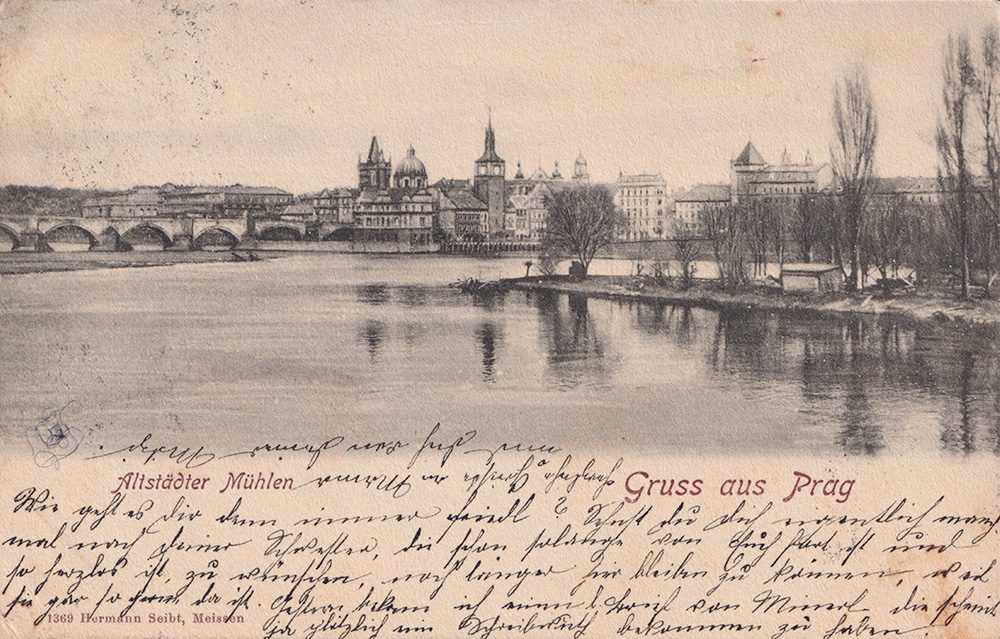
On our first evening we strolled down the cobbled street running past the hotel, passing underneath the Charles Bridge, and onto a quiet side street where we found a cosy looking restaurant called the Velkopřevorský Mlýn. The restaurant’s courtyard was decorated with fairy lights and squashes of all shapes, sizes and colours. We sat by a window at the back of the restaurant, which looked out onto a quiet, narrow waterway. A large wooden water wheel, attached to the building opposite, dominated our view out of the window. The restaurant promised traditional Czech cuisine, and what we ate was rustic and uncomplicated. I had goulash soup, served up in a huge hollowed-out loaf of bread. There was something decidedly cosy about the whole evening: the food, being beside water, the sheepskins draped over our chairs, the smell of woodsmoke in the air, surrounded by gourds and wickerwork.
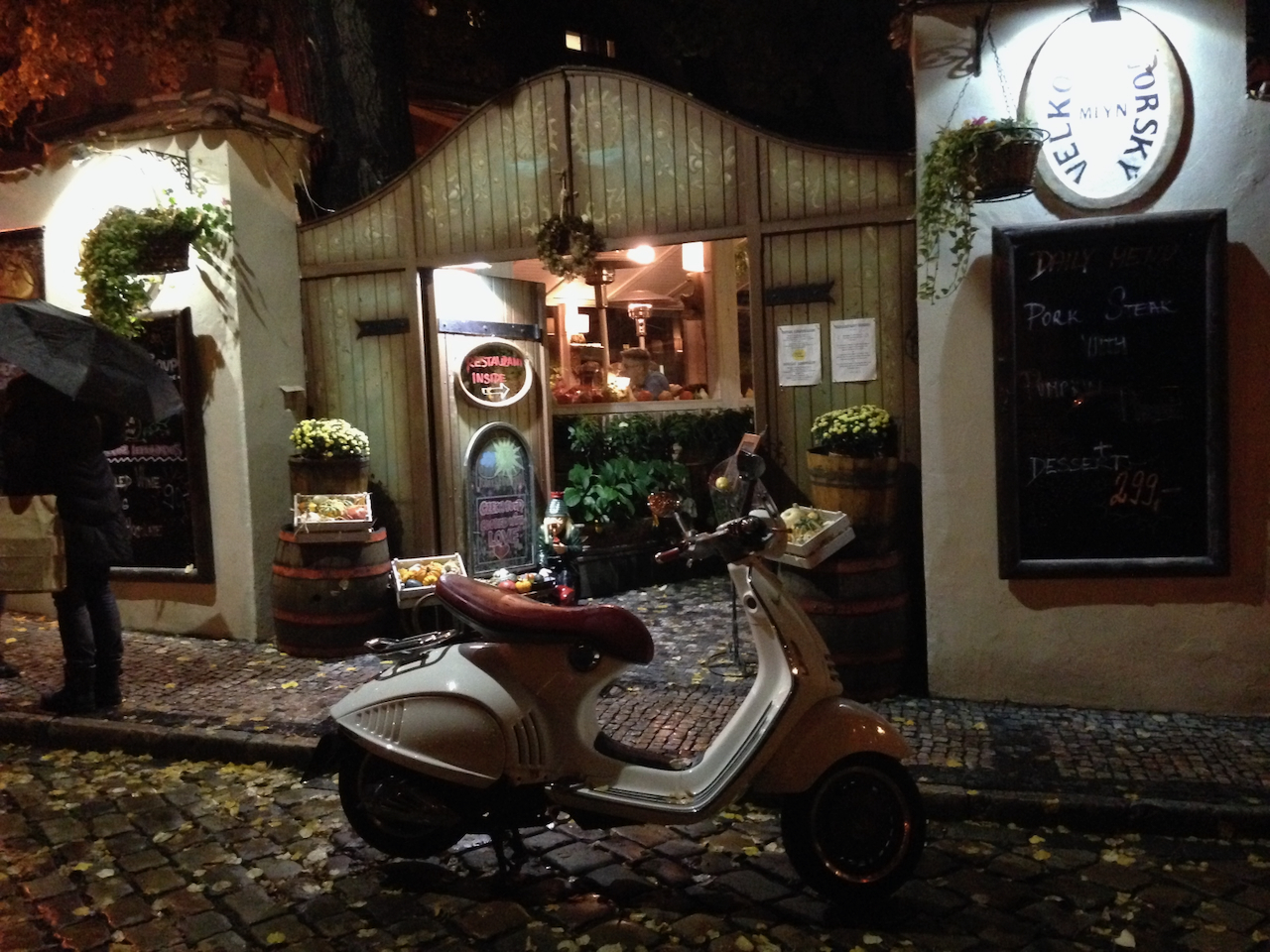
On the last day of our stay, before we checked out of our hotel and headed off to the airport, we walked down to a small park on the banks of the Vltava, close by to where we’d had dinner on our first evening. A row of horse chestnut trees lined the path along the edge of the river, their gold-flecked leaves reaching down towards the waters below. To our right, a row of bright yellow penguins stood on a wooden jetty. Made from recycled plastic, they were part of an installation created by the Cracking Art Group for the nearby Museum Kampa.
It is easy to regard quiet bucolic spots like this, in the midst of an historic city, as untouched. To think of them as somehow having resisted human agency throughout the years, and having survived into the present in more or less the same form. But are they really composed of fewer layers of history than other more built-up parts of the city, and do they really have less of a story to tell?
In this instance the answer is a resounding no, for the documented history of this place stretches back to the middle of the twelfth century. Sometime around 1156 the King of Bohemia Prince Vladislav II invited the Order of the Knights of Malta to create a base for themselves in Prague, having seen firsthand their contribution to the Second Crusade to the Holy Lands.1 The Order founded the Church of our Lady Beneath the Chain close by, so named after the chain that the Prague townspeople once strung across the Vltava to enable them to detain vessels and collect taxes from their crews. The Order also had the canal dug, allowing the construction of numerous watermills along its 700-metre length. One such mill was the Grand Priory Mill, or Velkopřevorský Mlýn, and the wooden water wheel that can currently be seen on the canal is a replica of the one once attached to the mill.2

The island acquired its current name Kampa (meaning campaign) in the seventeenth century. In the early stages of the Thirty Year’s War (1618–48) the island was used as an encampment by Catholic soldiers from Spain, Prague being on the Catholic side of the conflict. On the evening of 7 November 1620 a Spanish monk of the Barefoot Carmelite Order named Domenico a Jesu Maria, appeared at the camp with a painting of the Virgin Mary that he claimed had been defiled by Protestant troops. This outrage spurred the Spanish and their allies to victory against the Protestant forces of the Bohemian Confederation and Electoral Palatinate the following day, in a battle now known as the Battle of White Mountain.
The current name of the canal – Čertovka, or devil in English – is more recent, and is widely thought to date from the nineteenth century. The name derives from a local house known as the Seven Devils. According to folklore, six devils were painted on the front of the house, while a sharp-tongued woman – the seventh devil – lived inside. Another piece of Czech folklore associates a water sprite, or vodník, with the canal, and sharp-eyed visitors might notice a sculpture of the said sprite perched beside the canal, installed by artist Josef Nalepa in 2010 (reader: I didn’t).
So there you have it – watermills and campfires, devils and monks – scattered through history, and sitting cheek by jowl in an otherwise sleepy corner of Prague.
Enjoyed this article? Subscribe to In the Jungle of Cities:
- Dr. Mulan Buben “The History of the Order in the Czech Lands” Order of Malta: Grand Priory of Bohemia [http://en.maltezskyrad.cz/history-of-the-grand-priory-of-bohemia/, accessed 06/08/2024] ↩︎
- “Čertovka” Amazing Czechia [https://www.amazingczechia.com/sights/certovka/, accessed 06/08/2024] ↩︎
Like this article:
 In the Jungle of Cities